بقلم سانديب كومار ساكسينا، المفوض الهندي السابق لمياه نهر السند حول معاهدة مياه نهر السند بين الهند وباكستان …..
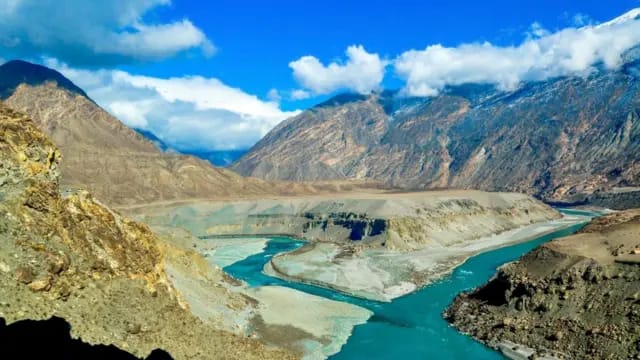
معاهدة مياه السند
التزامات غير متكافئة، وتنازلات غير عادلة، واستغلال باكستان للمياه كسلاح
الجزء الأول: هيكل غير عادل — كيف جرى تقنين حسن نية الهند في صورة تنازلات
1- معلومات أساسية: تقسيم النظام النهري
يتألف نظام نهر السند من ستة أنهار رئيسية هي: السند وتشيناب، وجهلم، ورافي، وبياس، وسوتلج، حيث تتدفق هذه الأنهار عبر أراضي كلٍّ من الهند وباكستان. يؤمّن هذا النظام احتياجات مياه الشرب والزراعة وتوليد الكهرباء في حوض السند، بما يدعم حياة مئات الملايين من السكان على جانبي الحدود.
عندما جرى تقسيم الهند البريطانية عام 1947، تم تقسيم نظام نهر السند أيضًا بين الدولتين الناشئتين. وكان الواقع الجغرافي آنذاك واضحاً: فالهند، بوصفها دولة المنبع، كانت تسيطر على منابع معظم الأنهار، بينما كانت الأراضي الزراعية التي تقع في قلب باكستان — سهول البنجاب كثيفة الري — تعتمد بصورة رئيسية على استمرار تدفق المياه القادمة من الشرق. كانت الهند بحاجة إلى الوصول إلى هذا النظام لتحقيق أهدافها التنموية في البنجاب وراجستان، مع سعيها في الوقت ذاته إلى تحقيق الاستقرار وتطبيع العلاقات مع جارتها الغربية الجديدة. ورغم احتياجاتها الداخلية الملحّة، أبرمت الهند هذه الاتفاقية شديدة السخاء لتقاسم المياه مع باكستان في 19 سبتمبر 1960، وهي الاتفاقية التي جرى التوصل إليها بوساطة البنك الدولي.
2- المفاوضات – الهند دفعت ثمن العقلانية
2-1 استراتيجية المماطلة الباكستانية ومقترح البنك الدولي لعام 1954
كان مسار المفاوضات، منذ البداية، غير متكافئ بين النهج الهندي المعقول والبنّاء وبين المطالب الباكستانية المتشددة، وأحيانًا غير المنطقية — وقد أدى هذا الاختلال إلى نتائج متحيزة لمصالح باكستان بصورة أكبر مما يقتضيه مبدأ العدالة. ويظهر ذلك بوضوح في أول مقترح مهم صدر عن البنك الدولي في 5 فبراير 1954؛ حيث فرض هذا المقترح، حتى في هذه المرحلة المبكرة، تنازلات أحادية كبيرة على الهند:
كان يتعين على الهند التخلي عن جميع المشروعات المخطط لها على المجاري العليا لكلٍّ من نهري السند وتشيناب، وكانت باكستان هي المستفيد من هذا الأمر.
كان مطلوبًا من الهند التخلي عن تحويل نحو 6 ملايين قدم-فدان من مياه نهر تشيناب.
لم يكن مسموحاً للهند باستخدام مياه نهر تشيناب عند ميرالا (الواقعة حاليًا في باكستان).
لم يكن مسموحًا بأي تطوير مائي في كوتش في إطار نظام الأنهار هذا.
ورغم هذه الأعباء الكبيرة، قبلت الهند المقترح بحسن نية وعلى الفور تقريبًا، في إشارة إلى رغبتها الصادقة في التوصل إلى تسوية سريعة. وعلى النقيض من ذلك، ماطلت باكستان في قبولها الرسمي لهذا المقترح لما يقرب من خمس سنوات، حتى يوم 22 ديسمبر 1958. ونتيجة لهذه البادرة الهندية القائمة على حسن النية، فُرضت القيود على الهند، بينما واصلت باكستان تطوير مشروعات جديدة على الأنهار الغربية دون قيود مماثلة. ومن ثم استخلصت باكستان درسًا مفاده أن التعطيل يحقق المكاسب وأن التعاون مكلف — وواصلت تطبيق ما تعلمته من هذا الدرس بصورة منهجية منذ ذلك الحين.
3- ما الذي خسرته الهند: حجم التضحيات
3-1 توزيع المياه
بموجب صيغة التوزيع الواردة في المعاهدة، حصلت الهند على حقوق حصرية في الأنهار الشرقية الثلاثة — سوتلج وبياس ورافي — بينما حصلت باكستان على حقوق في مياه الأنهار الغربية الثلاثة — السند وتشيناب وجهلم. وقد سُمح للهند ببعض الاستخدامات المحدودة وغير الاستهلاكية للأنهار الغربية داخل أراضيها، وبصفة أساسية لتوليد الطاقة الكهرومائية بنظام الجريان النهري، وذلك مع الخضوع لقيود تصميم وتشغيل واسعة النطاق.
ومن حيث الحجم، تحمل الأنهار الشرقية المخصصة للهند نحو 33 مليون قدم-فدان من المياه سنوياً، في حين تحمل الأنهار الغربية المخصصة لباكستان نحو 135 مليون قدم-فدان، ما يمنح باكستان حوالي 80% من المياه في هذا النظام، بينما حصلت الهند على 20% فقط، مقابل تخليها عن أي مطالبة في نظام الأنهار الغربي الأكبر بكثير. والنقطة الجوهرية هنا هي أن الهند لم تحصل على أي قدر إضافي من المياه بموجب الاتفاقية. فما حصلت عليه كان مجرد اعتراف رسمي بالتدفقات المائية التي كانت تستفيد منها بالفعل، مقابل تخليها عن أي مطالبة في نظام الأنهار الغربي الأكبر بكثير. كما سُمح للهند ببعض الاستخدامات غير الاستهلاكية للأنهار الغربية داخل أراضيها، وخاصة في مجال توليد الطاقة الكهرومائية بنظام الجريان النهري.
3-2 التنازل المالي: الدفع مقابل التخلي عن المياه
لعل أكثر جوانب المعاهدة إثارة للدهشة هو البند المالي. فقد وافقت الهند على دفع نحو 62 مليون جنيه إسترليني (ما يعادل تقريبًا 2.5 مليار دولار بالقيمة الحالية) كتعويض لباكستان لبناء بنية تحتية للموارد المائية في كشمير التي تحتلها باكستان. ويمثل هذا الأمر سابقة فريدة من نوعها قامت فيها دولة المنبع، التي كانت بالفعل متنازلة عن القدر الأكبر من مياه النظام، بدفع أموال إضافية لدولة المصب مقابل “امتياز” القيام بذلك. أي أن الهند قامت بتقديم دعم مالي لباكستان حتى تقبل باتفاق ينحاز بصورة كبيرة للمصالح الباكستانية فيما يتعلق بالقضية الأساسية لتوزيع المياه.
4- الخلل الهيكلي في المعاهدة
4-1 قيود غير متكافئة وأحادية الجانب على الهند
تفرض المعاهدة مجموعة محددة من القيود المتعلقة بالتصميم والتشغيل على استخدام الهند للأنهار الغربية، دون وجود التزامات مقابلة على الجانب الباكستاني، وهي:
لا يُسمح للهند إلا بتطوير مساحة محدودة من الأراضي الزراعية المروية (ICA) داخل أراضيها.
تواجه الهند قيودًا صارمة على حجم المياه التي يمكن تخزينها في أي منشأة تخزين على الأنهار الغربية.
يتعين على الهند الالتزام بمعايير تصميم محددة لأي منشآت كهرومائية على الأنهار الغربية، بما في ذلك القيود المتعلقة بسعة تخزين المياه.
وهذه القيود أحادية الاتجاه؛ إذ إنها تحدّ من تنمية الهند المشروعة لمواردها داخل أراضيها، دون أن تفرض أي التزامات مماثلة تتعلق بالشفافية أو القيود على باكستان. والنتيجة هي معاهدة تتعامل مع دولة المنبع — الهند — باعتبارها الطرف الذي يجب أن يخضع للرقابة والتقييد، بينما تستفيد دولة المصب من تدفقات مائية مضمونة.
معاهدة مياه نهر السند
التزامات غير متكافئة، وتنازلات غير متساوية، استغلال باكستان للمعاهدة كأداة ضغط
الجزء الثاني II: العرقلة والاستغلال والمساءلة التي طال انتظارها
1. استغلال باكستان للمعاهدة كأداة ضغط
1.1 العرقلة الممنهجة للتنمية الهندية
منذ توقيع المعاهدة، استخدمت باكستان باستمرار أحكام تسوية النزاعات الواردة فيها كأداة استراتيجية لعرقلة التنمية وتعطيلها فعليًا، بدلًا من اللجوء إليها بغرض تسوية النزاعات بصورة حقيقية. فكل مشروع رئيسي تقريبًا للطاقة الكهرومائية اقترحته الهند على الأنهار الغربية — حتى تلك المسموح بها صراحةً بموجب أحكام المعاهدة — واجه اعتراضات رسمية من جانب باكستان، أو طعونًا فنية، أو إحالات إلى التحكيم.
وقد خضعت مشروعات، من بينها باغليهار، وكيشنغانغا، وباكال دول، وتولبول، لتحديات واعتراضات باكستانية مطولة. وفي عدة حالات، أقرت باكستان بالفوائد المحتملة للمشروعات الهندية فيما يتعلق بتنظيم تدفق المياه — بما في ذلك الحد من الفيضانات — وفي الوقت نفسه واصلت معارضتها لها. ويكشف هذا النمط أن الاعتراضات الباكستانية لا تتعلق فعليًا بالامتثال للمعاهدة، بل تهدف إلى منع التنمية الهندية في جامو وكشمير، بغض النظر عن الأسس القانونية للمشروعات.
1.2 توظيف سردية “حرب المياه”
استغلت باكستان، في الوقت ذاته، التزام الهند الدائم بالمعاهدة لبناء وترويج سردية دولية تُصوِّر الهند باعتبارها “طرفًا قد يستخدم المياه كأداة عدائية”. وقد دأب المسؤولون والأكاديميون والقنوات الدبلوماسية الباكستانية على إثارة شبح “استخدام الهند للمياه كسلاح ضد باكستان” ضد باكستان — مستندين في ذلك إلى المعاهدة ذاتها التي التزمت بها الهند بدقة وحرص شديدين.
وقد أثبتت هذه السردية — التي تُصوِّر دولة المنبع باعتبارها مصدر تهديد — فاعلية ملحوظة لدى الأوساط الدولية غير المُلمة بتاريخ المعاهدة. واستخدمتها باكستان لتوليد ضغوط دبلوماسية، وكسب التعاطف متعدد الأطراف، وتقييد قدرة الهند على ممارسة حقوقها المشروعة بموجب المعاهدة.
وتتمثل المفارقة الأبرز في هذه الاستراتيجية في أن الهند لم ترتكب أي انتهاك واحد للمعاهدة — لا خلال حرب عام 1965، ولا خلال حرب عام 1971، ولا أثناء نزاع كارجيل عام 1999، ولا في أي مرحلة أخرى طوال خمسة وستين عامًا من سريان المعاهدة. فقد حافظت الهند على امتثالها الكامل لها، حتى في الوقت الذي استخدمت فيه باكستان أراضيها لشنّ أعمال إرهاب ترعاها الدولة ضد الهند.
2. العواقب بالنسبة للهند
2.1 الإمكانات التنموية غير المُستغلة
أدّت القيود التي فرضتها المعاهدة إلى آثار ملموسة وطويلة الأمد على التنمية في الهند ضمن حوض نهر السند. فما زالت مساحات شاسعة من ولاية راجستان وأجزاء من البنجاب، كان يمكن ريّها، تعاني من الجفاف أو تعتمد على مصادر مياه بديلة وأكثر تكلفة. ويمثل الفاقد من إنتاجية زراعية على مدار ستة عقود خسارة اقتصادية يصعب تقديرها.
2.2 الإمكانات الكهرومائية غير المستغلة في جامو وكشمير
كان تأثير المعاهدة على جامو وكشمير بالغ الحدة بشكل خاص. فهذا الأقليم الاتحادي يقع على امتداد الأنهار الغربية ويمتلك إمكانات هائلة للطاقة الكهرومائية غير المستغلة إلى حد كبير. إلا أن استغلال هذه الإمكانات يظل مقيدًا في كل مرحلة بسبب القيود التصميمية التي تفرضها المعاهدة، والاعتراضات المنهجية من جانب باكستان، والمخاطر المستمرة لنظام تسوية النزاعات متعدد المستويات وطويل الأمد. وقد بات السكان المحليون ينظرون بشكل متزايد إلى المعاهدة لا كإطار لتحقيق المنفعة المشتركة، بل كأداة لتهميشهم اقتصاديًا — أي قيد خارجي يمنعهم من تطوير الموارد الطبيعية التي تجري داخل أراضيهم.
2.3 تداعيات تأمين الطاقة
إن عدم قدرة الهند على تطوير إمكانات الطاقة الكهرومائية للأنهار الغربية بشكل أمثل يترتب عليه تداعيات مباشرة على تأمين الطاقة الوطنية. فقيود المعاهدة تعني أنه تم إهدار القدرة الإنتاجية المحتملة بشكل كامل بوصفها مصدرًا نظيفًا ومتجددًا وفعالًا من حيث التكلفة ، وذلك فقط نتيجة التعطيل الاستراتيجي من جانب باكستان، حتى فيما يتعلق بالحقوق المحدودة التي تمتلكها الهند بموجب هذه المعاهدة غير المتكافئة.
3. موقف الهند
كان الهدف من المعاهدة تحقيق “أكمل وأفضل استخدام ممكن لمياه أنهار السند” في “روح تتسم بحسن النية والصداقة” — وهو سياق لم يعد قائمًا.
تستمد المعاهدات مشروعيتها ليس فقط من قوة القانون، بل أيضًا من حسن النية في تنفيذ شروطها من قبل جميع الأطراف الموقعة. غير أن الاستخدام الموثق والمستمر من جانب باكستان للإرهاب المدعوم من الدولة كأداة من أدوات السياسة الخارجية ضد الهند — والذي بلغ ذروته في الفظائع التي شملت الهجوم على البرلمان عام 2001، وهجمات مومباي عام 2008، ومؤخرًا هجوم باهالجام في أبريل 2025 — يطعن بشكل جوهري في الأساس الذي تقوم عليه استمرارية التزام الهند بمعاهدة مياه نهر السند. لا يمكن تنفيذ الاتفاقيات الثنائية بصورة انتقائية: فلا يجوز لدولة أن تنتهك في الوقت ذاته القواعد الأساسية للسلوك بين الدول، ثم تطالب شريكها التفاوضي بالوفاء بالتزامات معاهدة تفيد الطرف الذي يخرق تلك القواعد بصورة غير متكافئة. ولا يمكن للمعاهدة أن تكون جزيرة من الالتزام الهندي داخل بحر من سوء النية الباكستاني. تمثل خطوة الهند تأكيدًا طال انتظاره على أن الاتفاقيات الدولية طريق ذو اتجاهين.
4. الخاتمة
لطالما جرى الاحتفاء بمعاهدة مياه نهر السند باعتبارها انتصارًا للدبلوماسية الدولية. غير أن هذه الورقة ترى أن هذا الوصف يشوّه بصورة جوهرية حقيقة ما حدث فعليًا: وهوعملية تفاوض جرى فيها مكافأة التعنت الباكستاني بتقديم تنازلات ، بينما استُغلت حسن نية الهند بصورة منهجية لإبرام اتفاق كان غير متكافئ منذ البداية.
ومع ذلك، تنازلت الهند عن 80% من المياه، ودفعت 62 مليون جنيه إسترليني (ما يعادل نحو 2.5 مليار دولار بالقيمة الحالية) لتسهيل هذا التنازل، وقبلت بقيود تشغيلية أحادية الجانب داخل أراضيها، كما حافظت على امتثال صارم للمعاهدة طوال خمسة وستين عامًا — بما في ذلك خلال الحروب المتعددة التي فرضتها باكستان، واستمرارها في رعاية الإرهاب العابر للحدود. وفي المقابل، حصلت الهند على معاهدة تم الاتفاق عليها بحسن نية، لكن باكستان استخدمتها كأداة لعرقلة التنمية، وروّجت من خلالها دوليًا لسردية “حرب المياه” من دون أي أساس واقعي، إلى جانب استمرار التخلف التنموي في مساحات شاسعة من الأراضي الهندية.
إن الخطوة التي اتخذتها الهند تأتي في إطار حماية مصالحها المشروعة في حوض نهر السند. فهي لا تمثل عملًا عدائيًا، وإنما تعكس تصحيحًا طال انتظاره لوضع غير متكافئ قام على حسن نية من جانب واحد لم يقابله التزام مماثل من الطرف الآخر. أما بالنسبة لمن يتساءلون عن سبب تعليق العمل بالمعاهدة في هذا التوقيت، فمن المهم التذكير بأن اتخاذ القرار الصحيح لا يرتبط بوقت متأخر أو مبكر.
THE INDUS WATERS TREATY
Asymmetric Obligations, Unequal Concessions and Pakistan’s Weaponisation
Part I: The Architecture of Inequity — How India’s Goodwill Was Codified into Concession
1. Background: The Partition of a River System
The Indus River System comprises six major rivers—the Indus, Chenab, Jhelum, Ravi, Beas, and Sutlej—flowing through the territories of both India and Pakistan. The system sustains drinking water, agriculture, and electricity generation across the Indus Basin, supporting hundreds of millions of people on both sides of the border.
When British India was partitioned in 1947, the Indus River System was also divided between the two successor states. The geographic reality was stark: India, as the upper riparian state, held the headwaters of most rivers, while Pakistan’s agricultural heartland—the heavily irrigated Punjab plains—depended critically on continued water flows from the east. India, for its part, required access to the system for its own development objectives in Punjab and Rajasthan, while seeking stability and normalised relations with its new western neighbour. Despite its own pressing domestic needs, India concluded this highly concessionary water-sharing pact with Pakistan on 19 September 1960, an agreement facilitated by the World Bank.
2. Negotiations – India paid the price for rationality
2.1 Pakistan’s Strategy of Delay and the 1954 World Bank Proposal
The trajectory of the negotiations was shaped, from the outset, by the asymmetry between India’s reasonable and constructive approach and Pakistan’s maximalist, sometimes absurd, demands — an asymmetry that anchored outcomes far more favourably to Pakistan than equity would have warranted. The World Bank’s first substantive proposal of 5 February 1954 illustrates this plainly: even at this initial stage, it required significant one sided concessions from India:
All planned Indian developments along the upper reaches of both the Indus and Chenab were to be abandoned, with those benefits accruing to Pakistan instead
India was required to forgo diverting approximately 6 MAF from the Chenab River.
No Chenab waters at Merala (now in Pakistan) would be available for Indian use.
No water development would be permitted in Kutch from the river system.
Despite these considerable impositions, India accepted the proposal in good faith almost immediately, signalling its genuine desire for a speedy resolution. Pakistan, by contrast, delayed its formal acceptance for nearly five years until 22 December 1958. As a result of this goodwill gesture of India, the restrictions were imposed on her while Pakistan continued developing new uses on the Western rivers without equivalent constraints. Pakistan absorbed the lesson that obstruction pays and cooperation costs—and has applied this lesson consistently ever since.
3. What India Lost: The Scale of Sacrifice
3.1 The Water Allocation
Under the Treaty’s allocation formula, India received exclusive rights to the three Eastern rivers—the Sutlej, Beas, and Ravi—while Pakistan received rights to the waters of the three Western rivers—the Indus, Chenab, and Jhelum. India was permitted certain limited, non-consumptive uses of the Western rivers within its own territory, primarily for run-of-river hydropower generation, subject to extensive design and operational restrictions.
In volumetric terms, the Eastern rivers allocated to India carry approximately 33 million acre-feet (MAF) of annual flow, while the Western rivers allocated to Pakistan carry approximately 135 MAF—giving Pakistan roughly 80 percent of the system’s water. India received 20 percent, in exchange for relinquishing all claim to the vastly larger Western system. The critical point is that India did not gain new water from the agreement. What India received was formal acknowledgment of flows it already accessed, in exchange for relinquishing all claim to the far larger Western system. India was permitted certain non-consumptive uses of the Western rivers within its territory—primarily run-of-river hydropower generation.
3.2 The Financial Concession: Paying to Give Away Water
Perhaps the most striking anomaly of the Treaty is the financial provision. India agreed to pay approximately £62 million (approximately $2.5 billion in present value) as compensation to Pakistan to build water resources infrastructure in Pakistan-occupied Kashmir. This payment represents a unique precedent in which the upstream country, which was already surrendering the majority of the system’s water, additionally paid the downstream country for the “privilege” of doing so. India essentially subsidised Pakistan’s acceptance of a deal that heavily favoured Pakistan on the fundamental question of water allocation.
4. The Treaty’s Structural Unfairness
4.1 Unilateral Asymmetric Restrictions on India
The Treaty imposes a series of specific design and operational restrictions on India’s use of the Western rivers that have no corresponding obligations on Pakistan’s side:
India can develop only a limited Irrigated Cropped Area (ICA) in its territory.
India faces strict limits on the volume of water that can be held in any storage facility on the Western rivers.
India must comply with specific design criteria for any hydropower facilities on the Western rivers, including restrictions on pondage and storage capacity.
These restrictions are one-directional: they constrain India’s lawful development of resources within its own territory while imposing no equivalent transparency or restriction requirements on Pakistan. The result is a treaty that treats the upstream state—India—as the party requiring oversight and restraint, while the downstream state benefits from guaranteed flows.
THE INDUS WATERS TREATY
Asymmetric Obligations, Unequal Concessions and Pakistan’s Weaponisation
Part II: Obstruction, Exploitation and the Long-Overdue Reckoning
1. Pakistan’s Weaponisation of the Treaty
1.1 Systematic Obstruction of Indian Development
Since the Treaty’s signing, Pakistan has consistently used its dispute resolution provisions as a strategic tool to delay and effectively obstruct development rather than genuine dispute resolution. Virtually every significant hydropower project India has proposed on the Western rivers—even those explicitly permitted under the Treaty’s terms—has faced formal Pakistani objection, technical challenge, or referral to arbitration.
Projects including Baglihar, Kishenganga, Pakal Dul, and Tulbul have all been subjected to prolonged Pakistani challenges. In several cases, Pakistan has acknowledged the potential benefits of Indian projects for regulated water flow—including flood moderation—while simultaneously opposing them. This pattern reveals that Pakistani objections are not genuinely about Treaty compliance; they are about preventing Indian development in Jammu and Kashmir, regardless of the legal merits.
1.2 The ‘Water War’ Narrative and Its Deployment
Pakistan has simultaneously exploited India’s consistent compliance with the Treaty to construct and disseminate an international narrative portraying India as a potential ‘water aggressor’. Pakistani officials, academics, and diplomatic channels have repeatedly raised the spectre of India ‘weaponising water’ against Pakistan—citing the very Treaty that India has scrupulously honoured.
This narrative—posing the upper riparian as a threat—has proven remarkably effective with international audiences unfamiliar with the Treaty’s history. Pakistan has used it to generate diplomatic pressure, attract multilateral sympathy, and constrain India’s ability to assert its legitimate Treaty rights.
The singular irony of this strategy is that India has not committed a single violation of the Treaty—not during the 1965 war, not during the 1971 war, not during the 1999 Kargil conflict, and not at any other point in the sixty-five years of the Treaty’s operation. India has maintained compliance even as Pakistan has used its territory to conduct state-sponsored terrorism against India.
2. The Consequences for India
2.1 Unrealised Development Potential
The Treaty’s constraints have had measurable, lasting consequences for India’s development in the Indus Basin. Vast areas of Rajasthan and parts of Punjab that could have been irrigated remain arid or dependent on alternative, more expensive water sources. The agricultural productivity foregone over six decades represents an incalculable economic loss.
2.2 Jammu and Kashmir’s Suppressed Hydropower Potential
The impact on Jammu and Kashmir has been particularly acute. The Union Territory sits astride the Western rivers and possesses enormous, largely untapped hydropower potential. Development of that potential is constrained at every turn by the Treaty’s design restrictions, Pakistan’s systematic objections, and the perpetual risk of multi-tiered long drawn dispute resolution mechanism. Local populations have increasingly come to view the Treaty not as a framework for shared benefit but as an instrument of their own economic marginalisation—an external imposition that prevents them from developing the natural resources flowing through their own territory.
2.3 Energy Security Implications
India’s inability to optimally develop the hydropower potential of the Western rivers has direct implications for national energy security. The Treaty’s restrictions mean that potential capacity—as a clean, renewable, and economically efficient energy source—has been sacrificed purely because of Pakistan’s strategic obstruction of even the limited rights India possesses in this asymmetric agreement.
3. India’s Case
The Treaty was intended achieve the “most complete and satisfactory utilisation of the waters of the Indus system of rivers” in a “spirit of goodwill and friendship”—a context that no longer exists.
The treaties derive their legitimacy not merely from the force of law but from the good faith implementation of their terms by all signatories. Pakistan’s documented and persistent use of state-sponsored terrorism as an instrument of foreign policy against India—culminating in atrocities including the 2001 Parliament attack, the 2008 Mumbai attacks, and most recently the Pahalgam attack of April 2025—fundamentally challenges the premise upon which India’s continued compliance with the IWT rests. Bilateral agreements cannot be selectively honoured: a state cannot simultaneously breach the foundational norms of inter-state conduct while demanding that its negotiating partner fulfil treaty obligations that disproportionately benefit the norm-breaker. The Treaty cannot be an island of Indian compliance within a sea of Pakistani bad faith. India’s step represents an assertion long overdue— that international agreements are a two-way street.
4. Conclusion
The Indus Waters Treaty has long been celebrated as a triumph of international diplomacy. This paper has argued that such a characterization fundamentally misrepresents what actually occurred: a negotiation process in which Pakistani intransigence was rewarded with concessions, and Indian goodwill was systematically exploited to produce an agreement that was inequitable from its inception.
Nevertheless, India surrendered 80 percent of the water, paid £62 million (approximately $2.5 billion in present value) to facilitate that surrender, accepted one-sided operational restrictions on its own territory, and has maintained scrupulous compliance for sixty-five years—including through Pakistan inflicted multiple wars and sustained sponsoring of cross border terrorism. In return, India has received a Treaty agreed to in good faith that Pakistan uses as a tool of developmental obstruction, a ‘water war’ narrative it deploys internationally with no factual basis, and the permanent underdevelopment of vast tracts of Indian territory.
India’s step is to protect its legitimate interests in the Indus Basin. This is not aggression; it is the long-overdue correction of an asymmetric arrangement premised on a goodwill that was never reciprocated. To those who ask why hold the Treaty in abeyance now, it would be useful to remember that there is no wrong time for a right decision.